
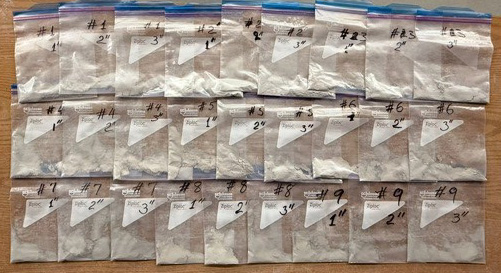
Powder samples obtained from different depths of concrete slabs prepared for chloride ion test
Chloride ion tests, sulfate ion tests, and carbonation depth tests are essential for concrete structures in order to achieve successful durability evaluations, compliance verification, and forensic investigations. Rehabilitation projects and renovation projects rely on accurate data from these tests to assess deterioration levels, plan repairs, and ensure the long-term preservation of aging infrastructure. At The Thompson & Lichtner Co. we provide chemical tests of cementitious materials in-house and in full accordance with ASTM C114 (Standard Test Methods for Chemical Analysis of Hydraulic Cement), AASHTO T260 (Sampling and Testing for Chloride Ion in Concrete and Concrete Raw Materials), and other relevant ASTM standards.
🧪 Chloride Ion (Cl–) Test
Chloride ions are a leading cause of reinforced concrete deterioration. Concrete’s natural alkalinity forms a passive film that protects embedded steel until chlorides penetrate and exceed threshold levels. Then corrosion begins.
Benefits of Chloride Ion Test
We perform both water-soluble and acid-soluble chloride ion tests at various depths to establish chloride concentration profiles. These profiles help determine corrosion potential, remaining service life, and appropriate rehabilitation measures—all particularly valuable for bridges, garages, marine, and coastal structures frequently exposed to de-icing salts and saltwater environments.
🧱 Sulfate Ion (SO₃) Test
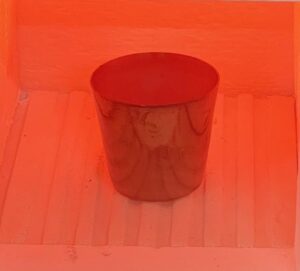
Muffle furnace running at 900 °C (1,652 degrees F) to obtain the sulfate ion content
Sulfate ions react with hydration products in cement paste—especially tricalcium aluminate and calcium hydroxide—to form ettringite and gypsum, which expand and cause cracking or softening.
Benefits of Sulfate Ion Test
Sulfate ion tests accurately determining sulfate (SO₃) levels, so that materials susceptible to internal or external sulfate attack are identified, helping ensure that repair materials and restoration designs are chemically compatible and durable.
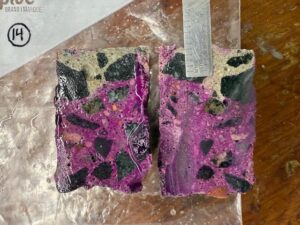
Measurement in progress on carbonation test of concrete cores
🌫️ Carbonation Depth Test
Carbonation occurring as atmospheric CO₂ penetrates concrete and reacts with calcium hydroxide, reducing alkalinity and destroying the steel’s protective environment. Over time, this process can lead to corrosion and surface distress.
Benefits of Carbonation Depth Test
Our carbonation depth test, conducted using phenolphthalein indicator per EN 14630 (European standard) guidelines, determines the depth of carbonation and the extent of pH reduction in concrete. This is especially important in older or historic structures, where long-term environmental exposure has altered the concrete chemistry. The results help engineers and preservation specialists evaluate the need for protective coatings, cathodic protection, or concrete replacement as part of a comprehensive rehabilitation plan.
✅ Why Choose Thompson & Lichtner?
- All tests are performed by qualified laboratory personnel under the supervision of our Director of Construction Materials Laboratory, ensuring strict compliance with ASTM standards and fully traceable QA/QC procedures.
- We deliver actionable data to support sound design, preservation, and repair decisions by combining chemical testing expertise with materials engineering insight.
- Whether for new construction, condition assessment, or historic rehabilitation, Thompson & Lichtner delivers accurate, defensible results backed by decades of experience.
The Thompson & Lichtner Co., Inc., an American woman-owned small business (WBE-SDO) founded 129 years ago, offers a broad range of engineering, testing, quality control, advisory, building envelope, and forensic services to the construction industry, particularly in areas of weatherproofing, moisture penetration, and air and water penetration. Our Construction Materials Testing division provides a wide range of routine and specialized services utilizing test specifications of ASTM, ANSI and other national standards setting organizations.
Contact us for further information and/or to schedule chloride ion, sulfate ion, and carbonation depth testing services.